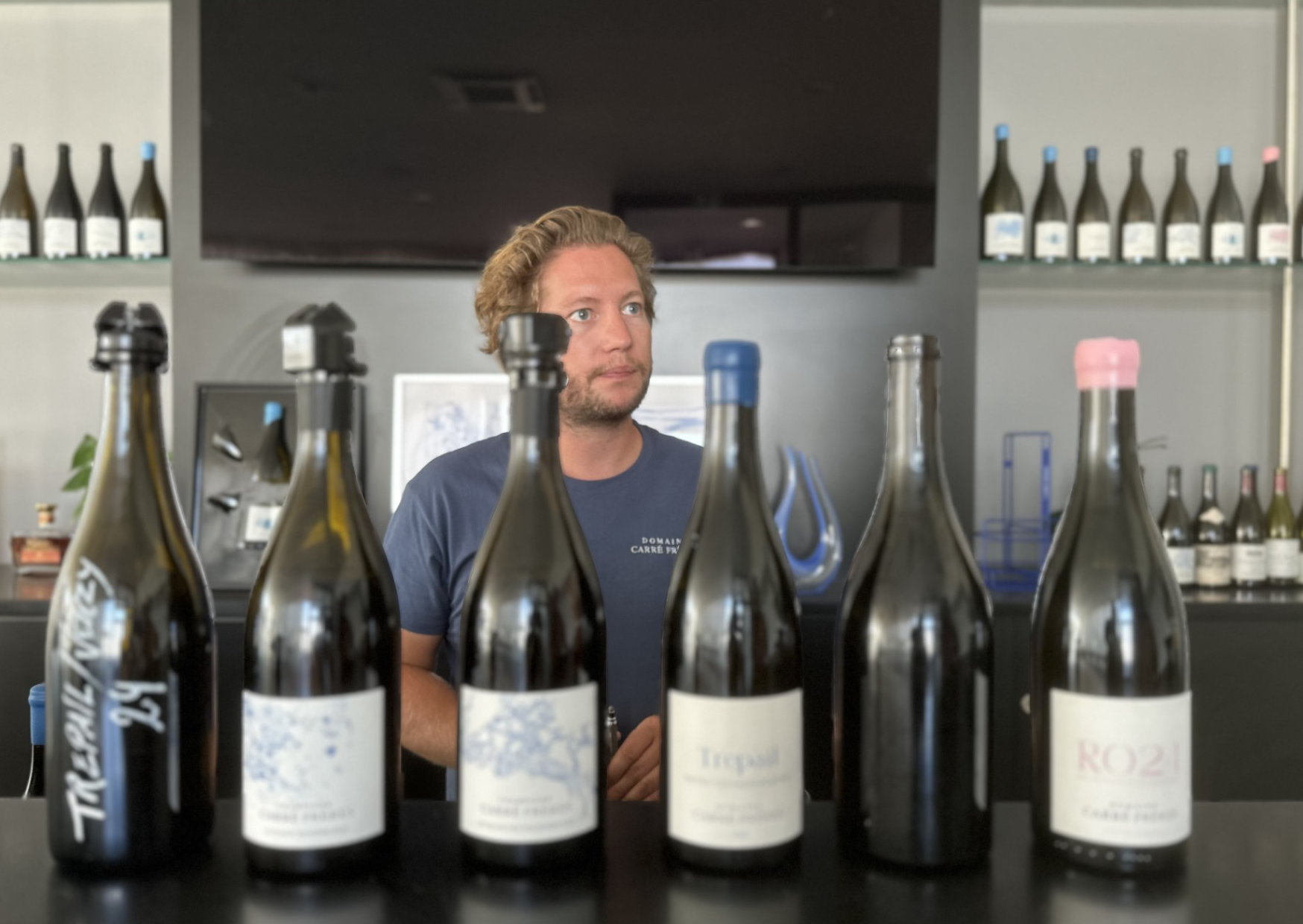
Ask why he does not make a non vintage Champagne, and the winemaker behind Carré Frère, Édouard Carré gives an answer that sounds almost like a complaint about the rest of the industry. If you go to a restaurant, he has said, the wine will be the same as last year and the year before that. He finds the idea repetitive, and has built an entire house around avoiding it.
Every Carré Frère bottle is vintage only. No reserve wines, no blending across years to smooth out variation, no attempt to make one vintage taste like the last. Each year is left to say what it actually was, in the glass, without correction. It is a position borrowed more from Burgundy than from Champagne, where the region's own village, premier cru and grand cru hierarchy has clearly shaped how he thinks about site and terroir coming first, consistency a distant second.
The label itself is young, only a handful of vintages old, sitting alongside the family's longer running classic label, which continues in parallel while it is gradually wound down to preserve its existing clients. Fifth generation in the vineyard, but the winemaker's own project only began in earnest recently, built on a two brother structure, one managing the vines, the other making the wine and handling everything else. Of the twenty five hectares the family farms, only three to four go into the label itself, mostly in Trépaille, a Premier Cru site with a generous south east facing exposure that does most of the heavy lifting. A smaller amount comes from Verzy. A parcel in the Aube, troubled by cold, heat and rocky soil that reflects sunlight back onto the grapes, is rarely used at all. The rest of the family's fruit is sold on, a decision that keeps the label small by choice rather than by constraint.
He is largely self taught, having built his palate by drinking widely rather than through formal training, and by his own account gravitated toward rich, wood influenced wines as the style he wanted to make. That shows immediately in the cellar. Everything is barrel aged, with no steel tanks anywhere in the process. He began with entirely new oak and has since settled closer to fifty per cent new across the range, alongside a slower shift from smaller three hundred litre barrels toward larger four hundred and fifty and five hundred litre formats, chosen for a better ratio of lees to wood and more benefit from regular lees stirring, a technique he treats as central to the wine's texture rather than incidental to it. Selection at the press is strict to the point of severity. Pressing stops the moment even one or two poor grapes appear, and only the first press, the cuvée, is used across every wine. The taille is discarded entirely.
Patience governs what happens after fermentation as much as before it. The current protocol runs roughly a year in barrel, followed by thirty months on lees in bottle, then a further six months after disgorgement before release, with an openly stated ambition to extend that further, to a year in barrel, forty months on lees, and a full year of rest after disgorgement, once volumes allow it. His own view on timing is direct. Champagne, he has said, really tastes good after a year post disgorgement, with six months as an absolute minimum. In practice this means holding back roughly half of every cuvée simply to let it age properly before it reaches a client at all.
The wines are sold exclusively to trade, restaurants and a small number of wine shops, with no direct sales to private clients. The reasoning is consistent with everything else about the house. Private clients, he has suggested, tend to drink a wine too quickly, before it has had the chance to become what it was built to become. Placing the wine with the right restaurants first protects both the wine and the reputation building around it.
It leaves a house that is, in its own quiet way, arguing against almost everything Champagne has trained its audience to expect. Not sameness, but difference, year on year. Not early drinking, but patience measured in years rather than months. Not scale, but a label kept deliberately small enough that every vintage can still be watched closely enough to matter.