What the Wines in The Gentlemen Tell Us About Its Characters
From Romanée Conti to Pétrus and Mouton Rothschild, wine in Guy Ritchie’s The Gentlemen is more than a marker of wealth. Look closely and it becomes part of the characterisation.

Credit: Christopher Raphael (The Gentlemen 2/Netflix)
There is a particular pleasure in seeing something you love treated properly on screen. Wine is so often used as shorthand. Champagne means celebration. An old Bordeaux means money. A dusty cellar tells us that a family has been wealthy for generations. The bottle itself is largely beside the point. The Gentlemen pays closer attention.
Watching the series, I found myself noticing not simply the calibre of the wines being opened, but how deliberately they seemed to have been chosen. Romanée Conti, Pétrus, Mouton Rothschild, Meursault: these are impressive bottles, certainly, but they are not interchangeable ones. More interestingly, the characters don't interact with them in the same way. Wine becomes part of the show's vocabulary for distinguishing old money from new, confidence from performance, and familiarity from the desire to demonstrate it.
It is a small detail in a series filled with beautiful houses, excellent tailoring, cars, watches and all the other familiar signals of wealth. But perhaps because wine has its own elaborate language of provenance, scarcity, vintage and reputation, it is particularly good at revealing the difference between possessing something exceptional and knowing how to live with it.
The theatre of Romanée Conti
Stanley Johnston's 2002 Romanée Conti is perhaps the clearest example in series one.
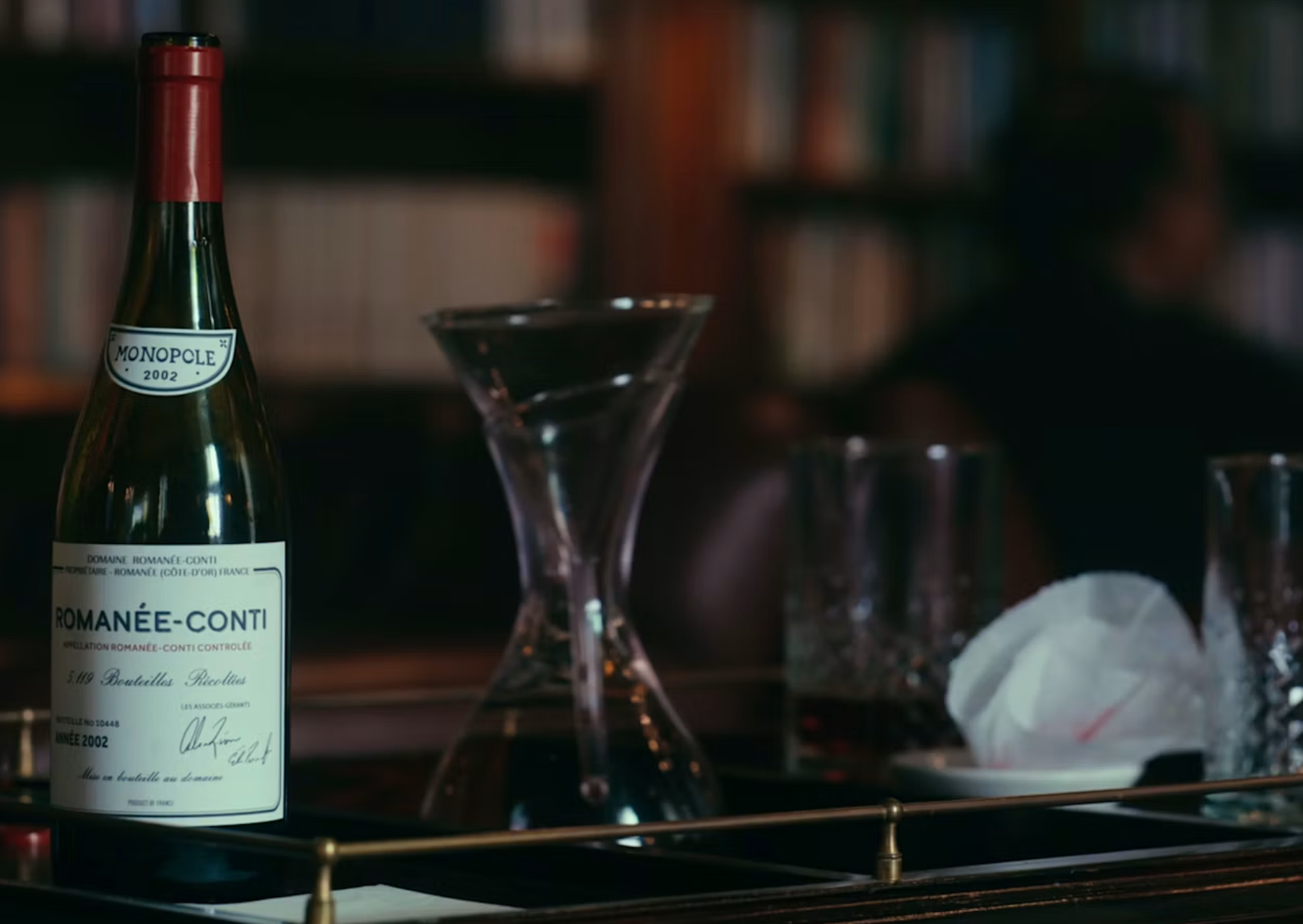
The 2002 Domaine de la Romanée-Conti featured (The Gentlemen/Netflix)
Played by Giancarlo Esposito, Johnston is a billionaire who appears to have cultivated every element of himself as carefully as his wardrobe. When a bottle of Romanée Conti appears, its rarity feels entirely appropriate. This is one of the most coveted wines in the world, produced from a tiny Grand Cru vineyard in Vosne Romanée by Domaine de la Romanée Conti. It is the sort of bottle for which price becomes almost secondary to access.
But the bottle itself is only half the story. Johnston doesn't simply open it. He performs it.
There is decanting, filtering and an elaborate process that culminates in the wine being returned to its original bottle. Wine professionals have quite reasonably questioned aspects of the technique. Watching it, however, I found the correctness of the service almost less interesting than the fact that Johnston feels compelled to have a process at all.
He cannot simply pour Romanée Conti. It has to happen according to his ritual.
That is what makes the scene work. The ceremony tells us something about Johnston that the label alone cannot. His relationship with luxury is one of control. Rarity is not enough; it must be understood, handled and presented on his terms. There is connoisseurship in it, but also performance.
And perhaps that is why Romanée Conti is such a good choice for him. A more obvious bottle might merely communicate money. Romanée Conti carries another layer: knowledge, scarcity, access and the suggestion that the person drinking it belongs to a very small club.
Whether Johnston genuinely belongs to that club, or simply needs everyone else to know that he does, is rather more interesting.
A bottle from the family cellar
Wine feels different at Halstead.
Eddie Horniman has inherited an estate, a title and a world whose complications extend considerably beyond the contents of its cellar. His relationship with wealth is consequently very different from Johnston's. It doesn't need to be assembled around him. It was there before him.
There is a lovely detail in the original script for the first episode in which Tammy goes to the family cellar and chooses a 2006 Meursault and a Pommard Premier Cru. There is no great ceremony around either bottle. Burgundy is simply downstairs. That casualness says an enormous amount. A Meursault taken from a family cellar to accompany dinner communicates a different kind of luxury from Romanée Conti being subjected to an elaborate tableside ritual. Neither is necessarily better, but they tell different stories about the people involved.
It is one of the things The Gentlemen understands particularly well. Wealth has dialects.
There is inherited wealth and acquired wealth, conspicuous wealth and almost invisible wealth. There are people who want you to notice the bottle and people for whom the bottle has always been there. The series plays constantly with these distinctions, and wine turns out to be an unusually effective way of expressing them.
It is also why the specificity matters. Meursault and Pommard aren't simply two expensive French wines. They place us very precisely in Burgundy, but on either side of its personality: Chardonnay from the Côte de Beaune on one hand, Pinot Noir on the other. It feels like the sort of pairing somebody might actually retrieve from a serious cellar rather than two labels selected because they looked suitably expensive on camera.
These are details most viewers will never consciously register. That is partly what makes them good details.
Pétrus, Mouton and knowing what you're looking at
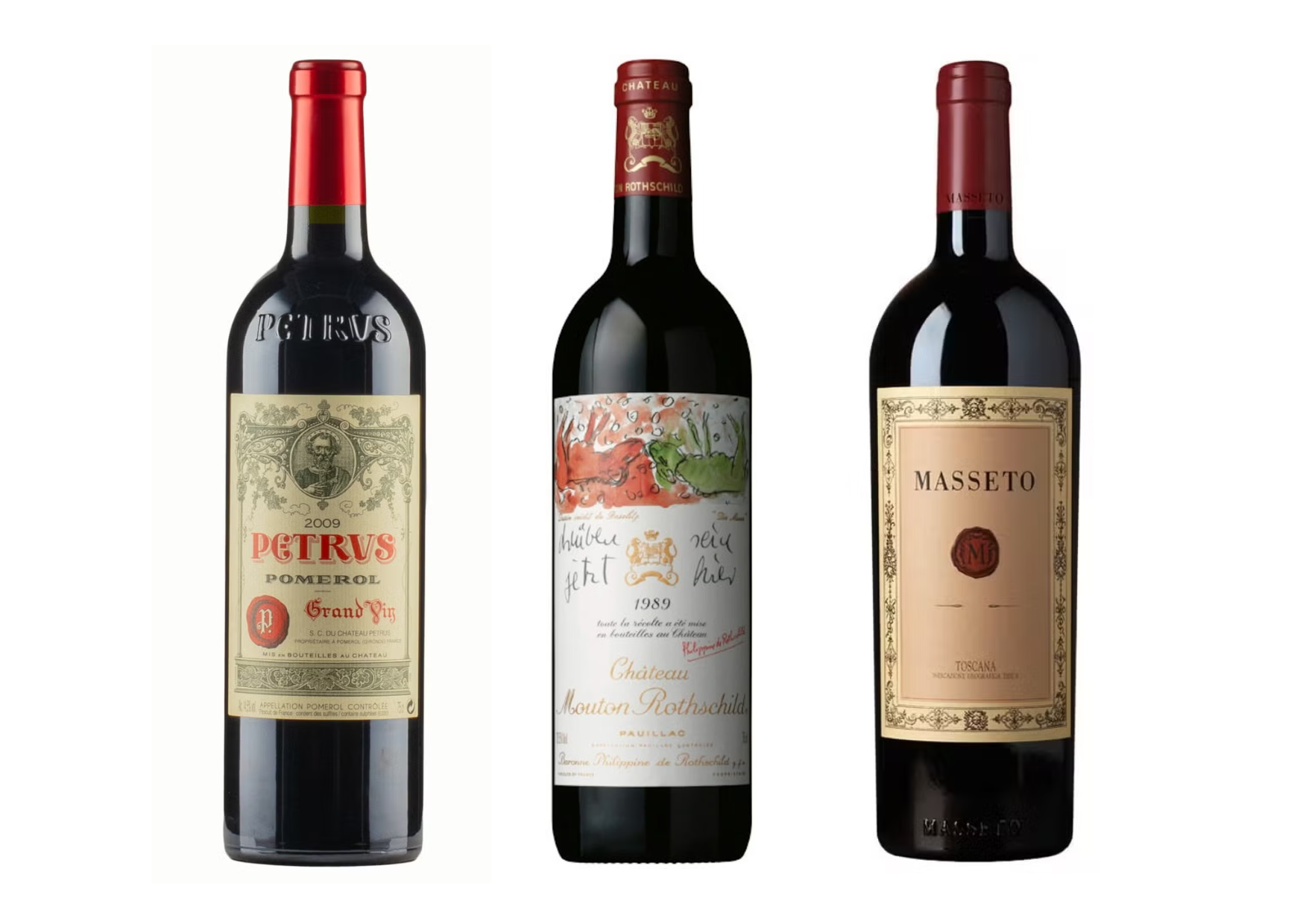
The pleasure continues as the world of The Gentlemen expands.
Pétrus appears. So does Mouton Rothschild. Masseto enters the conversation. There is even a moment involving a 1989 Mouton and the rather more consequential question of whether the bottle is corked.
For anyone interested in wine, there is an inevitable pleasure in recognition. You catch sight of a label and momentarily stop following the plot. Was that Pétrus? Which vintage? Did they really just open that? But again, the series doesn't need everyone watching to understand precisely what they have seen.
A bottle of Pétrus can sit in a scene and simply register as something important. If you know Pomerol, however, you know more. If you recognise Masseto, you understand why its appearance alongside the great names of Bordeaux is interesting. If somebody opens a 1989 Mouton Rothschild and declares it corked, there is an additional little tragedy available to anyone who understands what has just been lost. That last detail is particularly good because it punctures some of the reverence surrounding great wine.
However extraordinary the château, vintage or price, wine remains wine. A legendary bottle can disappoint. A cork can fail. Decades of careful storage and anticipation can end with someone raising a glass to their nose and realising that something isn't right. There is something rather satisfying about seeing that acknowledged.
It also gives the writers another way to reveal knowledge without resorting to exposition. Someone recognising a corked bottle tells us far more convincingly that they are accustomed to good wine than a line of dialogue explaining their expertise ever could.
That is the pleasure of detail. The programme doesn't have to explain the joke for it to work.
When taste becomes character

Theo James in 'The Gentlemen. (The Gentlemen/Netflix)
Film and television have always understood the usefulness of a drink. James Bond has his Martini. Champagne can tell us that something is being celebrated before anybody raises a toast. Whisky has spent decades signalling a particular kind of masculinity. A character ordering a drink at a bar can tell us something about themselves in a matter of seconds.
Wine offers writers an even richer vocabulary because there are so many layers to play with. Region. Producer. Vintage. Rarity. Price. Fashion. How a bottle is served. Whether somebody recognises it. Whether they feel the need to tell everybody else what it is.
The most interesting distinction is often not between people who drink expensive wine and people who don't. It is between the different ways people behave around it.
Some collect labels. Some collect vintages. Some want the table to know exactly how difficult the bottle was to obtain. Others open something extraordinary and barely mention it.
Knowing what is good, being able to afford what is rare and possessing genuine taste are not necessarily the same thing. The Gentlemen, a series fascinated by class and the complicated performance of status, has plenty of fun in the space between them.
Perhaps that is why wine sits so comfortably in Guy Ritchie's world. It can be both genuinely wonderful and faintly ridiculous. It can inspire obsessive knowledge and extraordinary generosity, but also snobbery, one upmanship and theatre. The same bottle can mean completely different things depending on who has put it on the table.
And that makes it useful for character.
The pleasure of noticing
There is a temptation, when you love wine, to become preoccupied with whether television gets every detail technically right. The Romanée Conti scene alone could sustain a lengthy argument about how one should treat an old Burgundy. I'm not sure that is the most interesting question here.
What I like about The Gentlemen is that somebody has paid attention.
The bottles haven't simply been chosen because their labels are recognisable or their prices sufficiently impressive. There is enough specificity to reward the viewer who happens to know what they are looking at. The wine has been allowed to carry some of the storytelling. That feels increasingly rare.
We live in a visual culture saturated with luxury objects, and television (and social media) has become extremely good at showing us beautiful things. But beautiful things become much more interesting when they reveal something about the person who chose them.
A Romanée Conti subjected to an elaborate ritual tells us one thing. A Meursault casually retrieved from the family cellar tells us another. A corked First Growth, recognised immediately, tells us something else again. None of those details needs to be explained for the scene to work.
But if you love wine, you notice.
And there is something particularly satisfying about seeing a series pay such close attention to something we love, then use that knowledge for more than decoration.
In The Gentlemen, wine isn't simply something expensive for the characters to drink.
It helps tell us who they are.